Windows 8 tablets are the real deal, people, and their unique charms tie directly back to the new OS.
Is Windows 8 an existential threat to Android tablets?
Nagging questions shadow the impending launch of Windows 8, threatening to scuttle Microsoft's plans to reinvent itself for the age of mobility. Will desktop users graciously accept the redesigned Modern interface? Will the Windows Store have enough apps to entice would-be Surface RT buyers? Can Windows 8 breathe life into sagging PC sales?
Microsoft: Surface beats the iPad in display quality
A Microsoft engineer tries to explain why he believes the display found on the Surface RT tablet is superior to that of the iPad even with a lower resolution..
Gigabyte Convertible Ultrabook Coming. U2142 has up to 1.2TB Storage
Gigabyte have demonstrated their swivel-screen U2141 Ultrabook and say it will be ready soon after Windows 8 launch. It’s an 11.6” model with much the same soul as the T1132 Booktop, a Core-based 11.6” convertible that existed outside the Ultrabook sector.
Microsoft Surface set to shift 3 million in 2012
The Microsoft Surface is set to ship 3 million units before the year is out and then a further 9 million next year, according to analysts.
Sunday, October 21, 2012
The Serene - ER
No comments
Nicholas Allegra, who was hired last year after gaining fame at JailBreakMe, was let go after not responding to an e-mail offering to extend his employment.
(Credit: James Martin/CNET )
Apple's experiment with employing a hacker famous for jailbreaking the iPhone has ended.
Nicholas Allegra, also known as Comex, was hired at Apple after gaining fame with the JailBreakMe, a Web site that simplified the process of removing Apple-installed protections from the phone -- a practice Apple opposes. When Apple hired him as an intern in August 2011, Allegra was a high-profile member of the jailbreaking community, regularly publicizing security vulnerabilities in Apple's iOS software.
However, Apple ended the 20-year-old Brown University student's employment last week, Allegra revealed today.
"So... no point in delaying. As of last week, after about a year, I'm no longer associated with Apple," he tweeted this afternoon. "As for why? Because I forgot to reply to an email," he wrote in a follow-up tweet.
"I wasn't too happy about it, but it didn't seem like I was able to fix it," he told Forbes. "So that's what it is."The e-mail he didn't reply to was an offer to extend his employment at Apple as a remote intern, Allegra told Forbes. After not responding to the original e-mail, he learned that the offer had been rescinded.
CNET has contacted Apple for comment and will update this report when we learn more.
Hackers have proven to be popular hires at tech companies these days. Charlie Miller, famous for his hacks on the iPhone and MacBook Air, joined Twitter last month, and well-knownPlayStation 3 hacker George Hotz, a.k.a. Geohot, had a brief stint at Facebook last year.
Saturday, October 20, 2012
The Serene - ER
No comments
If only we could all live and work in Silicon Valley. The New York Times reports that Evernote—the company behind the same-named app as well as others including Skitch and Penultimate—is giving its employees a fantastic perk: Housekeeping twice a month for everyone from receptionists to executives.
Anyone with a full-time job knows pulling off work-life balance isn’t easy. “The workplace was built on the assumption that there was somebody at home dealing with the home front,” Anne Weisberg, a longtime human resources executive and author on the subject, told The Times.
No kidding, but employee benefits can really help. Want more examples to covet? Here are four other Bay Area Internet companies that offer amazing perks we all wish we had.
Google
The search and advertising giant is widely known to offer some of the best employee benefits on the planet, including free gourmet meals, haircuts, legal advice, travel assistance, and much more.
And get this: If a U.S. Googler dies while working for the company, his or her surviving spouse or domestic partner gets a check for 50 percent of the person’s salary every year for ten years. Google doesn't even impose a tenure requirement.
Facebook
In addition to free food prepared by professional chefs, Facebook employees get free laundry service, haircuts, photo processing, and dry cleaning, not to mention reimbursement for day care and fully-paid-for medical, dental, and vision coverage.
Not only that, the company gives four months of paid maternity leave plus forks over $4000 in "baby cash" to new parents to cover day care and adoption fees.
Airbnb
It makes sense that the company that lets anybody rent out their couch for a night would encourage its employees to travel. Every employee gets $2000 a year to go anywhere on Earth—presumably staying with Airbnb hosts, you’d think.
They also can bring pets to work, enjoy organic lunches and yoga classes as well as play around with “Mustache Monday,” or oddly, dress up for “Formal Friday.”
Zynga
The gaming company’s logo smacks of play and features the silhouette of a dog, and not just any dog. Zynga is actually named after the late bulldog of CEO Mark Pincus.
It follows, then, that the place would be canine-friendly, and that’s an understatement if one has ever been made. The company encourages employees to bring their dogs to work, offers on-site grooming and even is building a dog park on the roof of its new headquarters, which, by the way, is dubbed “The Dog House.”
In addition to hang-time with furry friends, Zynga also gives employees free massages, acupuncture and hair cuts as well as stock, cash bonuses and trips. Oh, and everybody can take as much vacation time as they want.
Saturday, October 20, 2012
The Serene - ER
No comments
The $199 Beats Pill arrives in late October and comes in three colors: Black, red, and white.
(Credit: Beats Electronics)
In recent months I've reviewed several compact, portable Bluetooth speakers and the list ofJawbone Jambox competitors just keeps growing. One I've got my eye on is the $199 Beats by Dre Pill, which, needless to say, looks like a pill -- the capsule kind, anyway.
The Pill in red.
(Credit: Beats)
Early word is that this one sounds better than the Jambox and has a few extra features such as tap-to-pair NFC (for smartphones like the Samsung Galaxy S3 that have NFC) and apt-X technology for "easy and instant Bluetooth audio." Like the Jambox, this one also has speakerphone capabilities and a built-in rechargeable battery. A carabiner is included for clipping it onto your backpack.
The portable Pill recharges via USB.
(Credit: Beats)
With the product due to ship at the end of October, I should be getting a review unit fairly soon, and will put it up against the competition. While the Pill's a little pricey at $199 (the Jambox is now $179), at least Beats didn't bring it out at $250; if it performs well, it should be a force in this category.
Friday, October 19, 2012
The Serene - ER
No comments
HARRY MCCRACKEN / TIME.COM
Google Senior VP Sundar Pichai introduces the new Samsung Chromebook
Back in 2009, Google announced Chrome OS, an operating system for web-centric “Chromebook” laptops which would run online services and store almost everything in the cloud. Two years later, the first models — a $349 Acer and a $499 Samsung — shipped in mid-2011. (I made a good-faith effort to use the Samsung instead of my MacBook Airand didn’t have a great time.) New models have arrived since, including a Samsung version, which my colleague Jared Newman liked.
Whether Chromebooks have failed is open to debate, but they haven’t succeeded — if success involves widespread adoption by everyday folks. The contrast with the iPad, which was announced after Chrome OS, but which shipped more than a year before the first Chromebooks, is striking.
But Google hasn’t given up on the Chromebook. Actually, it seems to be redoubling its effort to make the concept work — and today, it’s announcing a new model, built by Samsung, that costs just $249.
Earlier Chromebooks were adopted by…well, early adopters. At a press event this morning, Sundar Pichai, Google’s Chrome honcho, said that the new one is aimed at families who’ll use it at home, in many cases as a second or third computer. That helps nudge it away from one basic Chromebook conundrum: They’re designed to be used mostly in places where Internet access is available.
This model — which has the Apple-esque moniker “the new Samsung Chromebook” — has an ARM processor (earlier models used Intel chips), an 11.6-inch matte screen, a full-sized keyboard and touchpad, a webcam, 16GB of local storage and two years’ worth of 100GB of Google Drive space. It’s less than 0.8 inches thick, weighs less than 2.5 pounds and is rated for up to 6.5 hours of battery life. It boots in 10 seconds and can do 1080p video at 30 frames per second.
It also sports some new Chrome OS features, such as the ability to remote-control Windows PCs and Macs, and the ability to begin a search on a Chromebook and route the results to Google Now on an Android Jelly Bean phone.
As before, the major selling pitch for Chrome OS and Chromebooks is the seamless simplicity of the cloud. You can log onto any Chrome OS device and have instant access to all your stuff, don’t have to think much about software upgrades and are safe from viruses.
Pichai says that this Chromebook, unlike previous versions, will be given a major mainstream marketing push: It’ll be advertised on national TV, it’ll be in 500 Best Buy stores and at Google retail kiosks, and it’ll be sold in Google’s own Google Play online store as well as at Amazon.com. It goes on sale on Monday, though it may take a little more time to arrive in stores.
So what will it compete with? Well, inexpensive Windows notebooks, although even the cheapest name brand ones are a bit more than $249 (and a whole lot clunkier than the Chromebook’s Ultrabook-like hardware). I asked Pichai if the machine will look like a tablet alternative, and he said that it will in some cases — the fact that it has a real keyboard makes it a more practical choice in many scenarios.
I’m still not sure about Chrome OS’s prospects, but the operating system has matured — more stuff works in offline mode than when the first models went on sale — and Google’s new target market sounds plausible. The $249 price point is also far more appealing. (In fact, I thought it sounded good back in March 2011.)
And with the TV commercials and widespread retail availability, it’ll get in front of plenty of consumers who’ve never heard of the whole concept. For them, this might as well be the first Chromebook, and it’ll be fascinating to see how they react to it.
Friday, October 19, 2012
The Serene - ER
No comments
Gigabyte have demonstrated their swivel-screen U2141 Ultrabook and say it will be ready soon after Windows 8 launch. It’s an 11.6” model with much the same soul as the T1132 Booktop, a Core-based 11.6” convertible that existed outside the Ultrabook sector.
See all the Gigabyte Ultrabooks and alternatives in our database.
The U2142 has both SSD and HDD and can be equipped with up to 1.2TB of storage, comes with Core i3 or i5, up to 16GB RAM, USB 3.0, HDMI, VGA, Bluetooth 4.0, and HSPA (option we assume.) The screen is 1366×768 although we’ve seen Gigabyte offer higher resolutions options in the past. Weight is 1.3KG
Gigabyte haven’t formally announced the product on their website yet and a previous Google reference has now been pulled from the site so we expect full details to go up soon. We’re tracking everything in the Gigabyte U2141 product page.
Starting price is around $999 but don’t expect the top-end spec on the entry-level model.
Friday, October 19, 2012
The Serene - ER
No comments
Nagging questions shadow the impending launch of Windows 8, threatening to scuttle Microsoft's plans to reinvent itself for the age of mobility. Will desktop users graciously accept theredesigned Modern interface? Will the Windows Store haveenough apps to enticewould-beSurface RTbuyers? Can Windows 8 breathe life intosagging PC sales?
Microsoft's future success depends on its ability to make serious, quantifiable, no-nonsense headway in the mobile market, but it’s not the only company with a massive stake in the ultimate fate of Windows 8. The new operating system will also have a major impact on Google. Just look at the list of Microsoft’s Windows 8 tablet and hybrid partners—Samsung, Asus, Toshiba, and the rest. They all make Android tablets, too.
Apple’s position in the tablet market is so dominant that it need not fear encroachment by Windows 8 devices. But most of Google’s hardware partners—especially the ones that make the larger, so-called productivity devices—need to ask themselves a tough question: Will Windows 8 obliterate consumer interest in Android tablets?
Early opportunity squandered
At least one expert thinks that this question isn't hard to answer. Forrester analyst Sarah Rotman Epps sees a bleak future for Android tablets.
The Kindle Fire HD, which emphasizes media consumption, is one of the few Android-based tablets that consumers want.
"No one's buying Android tablets other than Amazon or Barnes & Noble [models] anyway," she says. "If there’s a market for non-Apple tablets, it has been and will be Windows. It’s pretty clear that there just hasn't been any demand for Android tablets other than the niche earlier-adopter market, while Windows has mainstream consumer interest."
Despite being the only major tablet alternative for people who don't want to bite into Apple, Android has clearly had little impact on the tablet market. IDC's second-quarter tablet report shows that more than two-thirds of all tablet shipments originated in Cupertino, and even those numbers don't tell the full story. IDC (which is owned by PCWorld’s parent company IDG) and other top research firms track tablet shipments to retailers, not tablet sales to customers. So when you take into account that some variable proportion of shipped Android tablets languish unsold on retailers' shelves, Android's situation may be even bleaker than IDC's numbers suggest.
In the recent Apple vs. Samsung case, for example, court filings showed that Samsung had managed to sell only 712,000 Galaxy Tab 10.1 tablets in the United States since the slate's launch. Those are sad numbers, given that many observers considered the Galaxy Tab 10.1 to be the perfect iPad alternative for much of 2011.
Also troubling for Google's operating system is the fact that the Kindle Fire—Android's brightest tablet star and best tablet seller—is not the droid you're looking for. It runs a proprietary, heavily skinned interface that renders it more of a content delivery system for Amazon than a proper Android tablet.
Ominously, the Kindle Fire accounts for the majority of Google tablet sales. IDC claims that Amazon is the world's third-most-prolific tablet manufacturer, even though Amazon sells its slate only in the United States. And reports from ComScore, Pew Research, and Amazon itself indicate that the Kindle Fire outsells all other Android tablets combined.
In other words, Android owes most of its slim slice of market share on an Android tablet that doesn't look or feel at all like a pure Android tablet. Google's baby is sucking wind, folks.
Cue the Windows 8 tablets.
Windows 8 and its direct Android prey
Finding agreement among tech industry analysts is always a challenge. Nonetheless, all the analysts I consulted agree that Windows 8 tablets will devastate the handful of productivity-focused Android tablets on the market, such as the Asus Eee Pad Slider and the Asus Eee Pad Transformer series. Whereas security concerns have prompted risk-averse corporations to shy away from Android tablets, Microsoft's operating systems sport deep, business-friendly features—including the all-important Microsoft Office.
IMAGE: LOYD CASEA Windows 8 productivity machine like the Asus Vivo Tab could threaten existing Asus products like the Eee Pad Slider and Transformer series.
"I think [productivity-focused Android tablets] are going to fade away," says Rob Enderle, the principal analyst of the Enderle Group, summing up the group consensus. "I think we'll see Windows convertibles and hybrids pick up that category. The keyboard really goes with Office."
The analysts I contacted also agree that Windows tablets will quickly gobble up Android's market share in the premium-priced tablet segment. Dropping $500 or more on a 10.1-inch Android tablet requires a lot more deliberation than spending $200 on a 7-inch Google Nexus 7. For this reason, analysts believe, consumers will flock toward the more seamless (and less glitchy) Windows experience when going for a big-screen (and non-iPad) tablet.
But will Android tablets vanish entirely? Most of the experts I spoke with don't think so. Excluding Forrester's Rotman Epps, most analysts expect Android tablets to be around for the long haul, albeit in a niche role that focuses on low prices and media playback.
A possible path for Android success
"I think there will be a market for 7- to 10-inch, very inexpensive Android tablets," says Patrick Moorhead, president and principal analyst at Moor Insights & Strategy. "Not from the major makers, but off-brand. Android tablets will be the budget option."
Google's Nexus 7 is squarely focused on consumption, not productivity.
"There’s a reason why Google came out with the Nexus 7," says Gartner's Carolina Milanesi. "It basically was a very loud message to the OEMs saying, 'Stop trying to be Apple, because you're not. And you're not going to be successful competing at that price point or that form factor. Go cheap. Go $199, so it becomes more of an impulse buy, and consumers will get them and watch videos, listen to music and play games.' All of which is very much media-centric and content-centric."
Enderle agrees, calling the Nexus 7 "the quintessential Android tablet, almost entirely focused on consumption, and that's probably where Android is going to continue to shine."
Rotman Epps doesn't buy this analysis, though: "Other than Amazon, [OEMs] just aren't selling any Android tablets. The iPad mini, if that comes out as we expect it to, will be the final nail in the coffin for Android tablets."
The other analysts think that if Android tablets do die off, it will be due to other causes entirely: lawsuits and Google's lackluster OEM support.
Manufacturers fear the reaper
Even if customers suddenly decide to support Android tablets, OEMs may not stay in Google's camp now that Microsoft has joined the fray. The analysts we contacted say Google's reputation for dealing with manufacturers is spotty at best; in contrast, OEMs generally enjoy working with Microsoft, occasional Surface tablet tensions aside.
IMAGE: LOYD CASEAfter suffering considerable grief over its Android devices, will Samsung give preferential treatment to its Windows 8 tablets, like this ATIV SmartPC?
Hardware manufacturers jumped on the Android bandwagon primarily because it was the only way for them to join the tablet revolution. In that sense, Apple helped spawn Android tablets, but now Apple might be the hammer that drives manufacturers away from Android for good.
"What really triggered the trend [of manufacturers hedging their bets with Android devices by also developing Windows devices] isn't so much customer satisfaction issues as much as that $1 billion judgment against Samsung," Enderle says, pointing to the sudden ramp-up of Windows Phone development by HTC and Samsung as examples.
"A lot of the OEMs really sweat bullets about being next on that particular list. Apple's actually doing Microsoft one hell of a favor here. That $1 billion judgment made 'free' not so free,” Enderle notes, referring to the ostensible price that Google charges OEMs for Android.
Gartner's Milanesi agrees that the risk of litigation from Apple encourages OEMs to see the value in adopting a Microsoft OS that costs money up-front. When you're in the Microsoft fold, she says, you're protected against Apple lawsuits, and Redmond also chips in with marketing costs and support for the developer community.
Where do manufacturers stand?
What do the companies that have skin in the game think about Android tablets' prospects for long-term survival? On the record, they're decidedly less pessimistic than the analysts are, which should come as no surprise, as they have to be cautious when making comments that might reflect on their roadmaps. Nonetheless, the OEMs do acknowledge the altered role that is likely to define Android's future.
Jay Parker, Lenovo's head of consumer/SMB operations for North America, recently told AllThingsD that the company plans to offer Android tablets "for the foreseeable future," but that it will offer only Android slates built in the Kindle Fire mold: small, cheap, and designed for playing around.
"We see them as pure media-based devices, where people are going to be surfing the Internet, reading books, or watching a movie, and really not a heck of a lot else," Parker said.
Acer makes the W510 Windows 8 tablet, but says that it's definitely not abandoning Android.
When asked whether Acer plans to support both Android and Windows 8 tablets, Paul Tayar, Acer America's director of product marketing for connected devices, unequivocally says "yes."
"The more ecosystems that we can play with and have available, the better we, as OEMs, can come up with developing the right hardware for the right consumer,” Tayar says. “Having options available to us lets us bring fresh solutions, and fresh designs, and fresh technology to the table."
Tayar feels there's enough consumer interest to support “even more than three” distinct operating systems, largely because of the very different user experiences offered by Windows 8 and Android. Windows tablets are more focused on productivity and might be more suitable for stationary office settings, whereas Android tablets tie deeply into Google's cloud-connected vision, and might appeal to people interested in everyday, on-the-run use, thanks to their smaller sizes.
Acer plans to tailor its hardware to take advantage of the specific ecosystem advantages of Windows 8 and Android. "You will not see a Windows 8 tablet, and then see the same tablet two days later with Android," Tayar says. He doesn't think Android will disappear any time soon.
"The Android market space, in both tablets and smartphones, is pretty much vindicated by the number of applications that are out there," he says. "That market has been validated. It's the real thing. It's not something that you're wondering 'Is this space going to exist or not?'"
You thought the Windows Store lacked tablet apps?
Tayar's last comment raises an interesting point: None of the analysts I spoke with think Android as a whole is in danger of dying, as the phone platform remains quite strong. Google Play features an abundance of Android apps—more than 675,000 by Google's last count—and the overwhelming majority of them are designed for smartphones, not tablets.
But that situation, too, is a double-edged sword for Google, as Android phone apps tend to translate poorly to the tablet experience.
IMAGE: ROBERT CARDINIronically, for all its inventory problems, the Windows Store may quickly eclipse Google Play in terms of pure tablet apps.
"Microsoft hasn't even launched the Windows Store yet, and it probably has five times more tablet applications than Android does," Moorhead says. For context, consider that the original 7-inch Samsung Galaxy Tab kicked off the Android tablet effort nearly two years back.
Despite some blustery talk by Google chairman Eric Schmidt, signs indicate that Google is finally beginning to understand how serious the Windows tablet threat is. Google recently improved its Google Play developer console and finally—finally!—introduced a set of tablet design guidelines for developers. "I think that they'll even give incentives for developers to develop applications," Moorhead says.
Incentives are crucial because Microsoft is gunning for those same developers, with an extensive support system that draws raves from developers. If Google wants an Android future on anything other than smartphones and embedded systems like Google Glass, it must convince some of those developers to create tablet-specific apps for its OS.
Yea or nay: Will Windows 8 tablets kill off Android?
Android tablets won't burst into flames on October 26 in some kind of self-destructive conflagration. Manufacturers won't pack up and leave Google holding the bag just because Microsoft is selling tablets—at least not initially. But serious questions loom over the launch of Microsoft's next-gen operating system, and until the company can allay some of those concerns, partners like Acer, Asus, and Lenovo will probably ride the fence until a clear market winner emerges.
But Microsoft isn't afraid to play the long game or to toss billions of dollars at marketers and manufacturers to ensure that its tablet initiative ultimately pays off. When—not if—Microsoft clears the initial hurdles, Google will have to step up its own game to ensure that Android tablets have a fighting chance, even as budget options.
Sure, Android might be the best choice for inexpensive media slates. But Google needs to get busy to bolster even that path to success, especially if Apple releases a miniature iPad. Google must do more to stimulate app development. It must work more amicably with OEMs. And it must step up to the plate, and protect its partners from Apple's litigious wrath.
If Google doesn’t do all of these things, manufacturers could very well throw up their hands and join the Windows team for good. Then we'd see the classic Apple/Microsoft duopoly all over again, this time in the mobile arena instead of on the desktop.
Will Windows 8 tablets kill Android tablets? Only Google can answer that question.
Friday, October 19, 2012
The Serene - ER
No comments
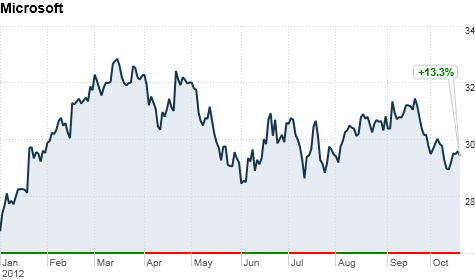
Click chart to see more information about Microsoft's stock.
NEW YORK (CNNMoney) -- As Microsoft prepares to launch Windows 8 -- a product it hopes will be transformative -- the company posted financial results on Thursday showing that its sales are treading water.
PC sales have been woeful, dragging Windows revenue down 9% during the quarter. Windows sales typically stall ahead of an anticipated new product launch, and Microsoft is gearing up for a massive one: Windows 8 and Surface, the first PC tablet of the company's own design, will go on sale Oct. 26.
But Microsoft gave no indication Thursday that Windows 8 or Surface will do anything to quickly change that trend. Windows sales to businesses are slowing, the company said, and economic conditions -- particularly in Europe -- are increasingly tough. Microsoft declined to give an outlook for either product, only saying that the company is "excited" about the launches.
Wall Street analysts, grasping at straws for any hint about how Microsoft's biggest product launches in nearly two decades will fare, got no help from Microsoft Chief Financial Officer Peter Klein on a conference call held Thursday afternoon.
When asked why Microsoft's estimate for growth in the cost of goods delivered was only in the high single digits for the current quarter if the company felt the expensive Surface tablet would sell well, Klein answered only: "We'll see how it goes. Next question."
Another question, about negative reviews mentioning Windows 8's potentially confusing user interface, got a pat response from Klein: "In the past, innovations delivered way more value, capability and usability."
Microsoft seems to be taking the same wait-and-see approach to Windows 8 that analysts expect potential customers to take.
The company's other divisions fared better during the quarter, helping to keep overall sales flat year over year. Sales of Office rose 1%, excluding some revenue deferrals for Office upgrades that were given to the recent crop of Office 2010 users. They will receive free upgrades to Office 2013 when that product launches in the next few quarters.
Strong sales in the Server and Tools division -- up 8% -- were boosted by continued demand for Microsoft's updated SQL Server product for businesses, which was released in April. Slightly higher online services sales were helped by a 15% rise in ad revenue -- mostly due to more Bing searches.
Xbox slipped 1% thanks to a slumping video game console market.
Overall, the Redmond, Wash.-based company had revenue of $17.3 billion in its fiscal first quarter. Those results include $1.4 billion in early Windows 8 and Office sales that the company has chosen to defer until the next few quarters. Excluding that deferred revenue, Microsoft had sales of $16 billion, short of the $16.4 billion analysts surveyed by Thomson Reuters were expecting.
Microsoft said its net income fell 22% to $4.5 billion for the quarter, which ended Sept. 30. Those results did not include a charge of 13 cents per share for the deferred Windows and Office sales. Including the charge, Microsoft earned 53 cents per share. Wall Street analysts, who stripped out the deferred profit from their estimates, had expected earnings of 56 cents per share.
Rival Google(GOOG, Fortune 500) also reported its quarterly finances Thursday, posting a 20% drop in earnings year over year, on struggles in mobile. Apple(AAPL, Fortune 500) is on deck, set to report its earnings on Oct. 25.
Friday, October 19, 2012
The Serene - ER
No comments
Apple loses an appeal against Samsung after the first judge claimed the Galaxy Tab 10.1 could not have infringed the iPad because it wasn't "cool" enough. Next up: Apple must run "apology" ads.
Apple has lost an appeal against Samsung in an ongoing U.K. case over design patents relating to the iPad.
A U.K. High Court appeals judge ruled in favor of Samsung at a hearing this morning, finding that the Samsung Galaxy Tab 10.1 had not infringed Apple's design patents relating to the iPad.
The original case in July heard Judge Colin Birss overseeing the case saying the Samsung tablets were not "cool" as the iPads, because the software did not feature the "extreme simplicity" that the rival Apple product has.
Birss also ruled in the original case that Apple must run "advertisements" in British newspapers and on its Web site stating that Samsung did not infringe Apple's design patents and therefore did not break U.K. law.
The notice on Apple's U.K. Web site must display the banner for six months in order to "correct the damaging impression" left by Apple following the legal wrangling.
Samsung welcomed the appeal, a spokesperson told the BBC News: "Should Apple continue to make excessive legal claims in other countries based on such generic designs, innovation in the industry could be harmed and consumer choice unduly limited."
But a lawyer representing Apple said at the time it would be "prejudicial" to Apple to issue such a statement without an appeal. (Even for quirky British law, it's a strange punishment to dish out.)
However, soon after the decision was made, Apple applied for a stay on the running of the so-called "advertisements," allowing the Cupertino, Calif.-based technology giant to appeal the verdict.
Now that Apple has lost its appeal, it's understood that the advertisements will go ahead. There isn't a specific time frame for when they will be served out to the British media, but we have reached out to Apple for comment and will update if we hear back.
This story originally appeared at ZDNet's Between the Lines under the headline "Apple loses U.K. Samsung appeal; must run 'apology' ads
Thursday, October 18, 2012
The Serene - ER
No comments
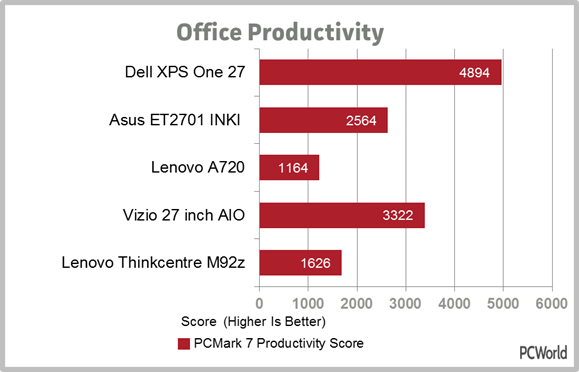
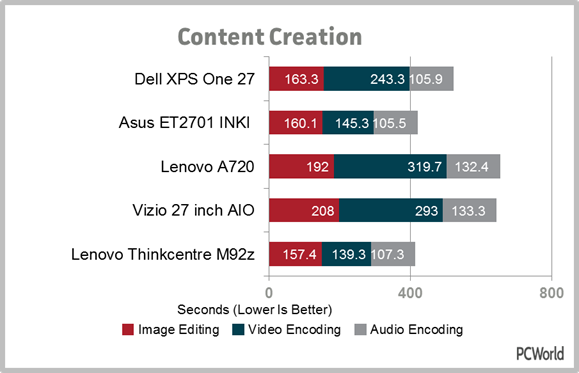
In today’s business world, the keys to getting the most out of your computer are productivity, space, and power—and the Lenovo ThinkCentre M92zall-in-one desktop PCepitomizes efficiency. Its 23-inch screen and compact dimensions take up little desk space in today's crowded office environments.
At $1247 (as configured, as of September 19, 2012), the ThinkCentre M92z represents a significant investment if a business plans to outfit its entire office with new machines, but it provides the power to back up the price. This true desktop system doesn't rely on laptop-style construction, and the result is better performance. The M92z comes outfitted with an Intel Core i7-3770S processor that runs at a standard 3.1GHz. A healthy 8GB of RAM supports optimal multitasking; when you run spreadsheets and browsers on this all-in-one, they'll seem as light as air.Battling the benchmark
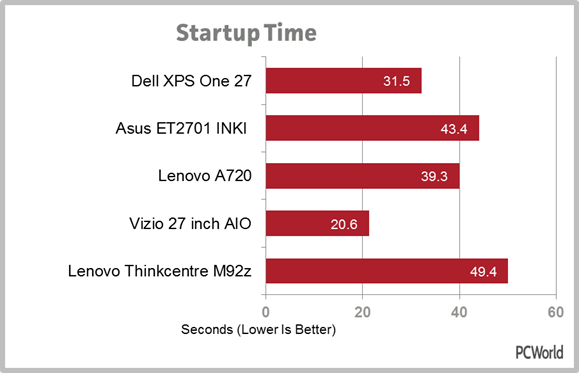
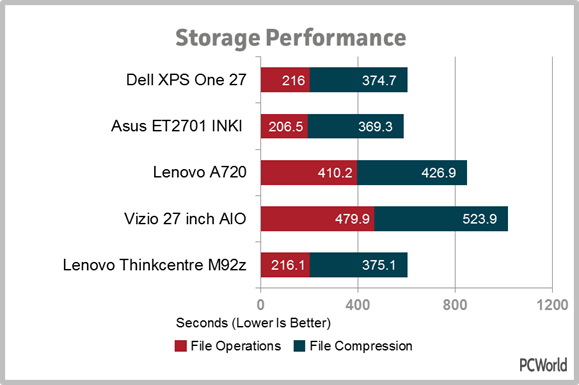
On our strenuous WorldBench 7 benchmark suite, the M92z earned a score of 91—about 9 percent slower than our baseline system. By way of comparison, the Vizio CA27-A1 27-inch all-in-one, also priced at $1250, racked up a mark of 122. In part, the big difference in scores is attributable to Vizio’s quick startup time (20.6 seconds), which is less than half as long as the M92z requires (49.4 seconds). The Vizio included a small SSD as cache to support its included 5400-rpm 1TB drive; that SSD cache also improves performance in the content creation and office productivity benchmarks. The M92z has a 1TB (7200-rpm) hard drive that manages to outperform the Vizio on most normal hard-drive benchmarks, however, so take that into account when you're choosing a business system. The Vizio would be a good choice for a larger, prettier screen, but for pure productivity the Lenovo comes out ahead.
All work and no play
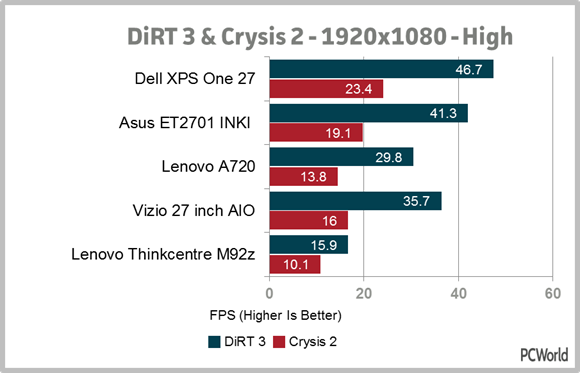
Don’t expect too much gaming performance from the M92z. The all-in-one comes with Intel’s integrated HD Graphics 4000, though you have the option to move up from that to an AMD Radeon HD7650 with 1GB of memory. When we ran our graphics benchmark at the highest quality settings and a resolution of 1920 by 1080 pixels, the M92z managed average frame rate of 15.9 frames per second on Dirt 3 and 10.1 fps on Crysis 2—about what you'd expect with Intel's GPU. When we lowered the graphics qulity setting and dropped the resolution to 1024 by 768 pixels, the M92z ran Dirt 3 surprisingly well (65.3 fps), but Crysis 2 still struggled at a playable but far from pretty 34.2 fps. Of course, gaming performance is rarely a major consideration for business desktops.
The screen is a 23-inch multitouch display with antiglare capability and a maximum resolution of 1920 by 1080 pixels. The screen gives a good 178-degree viewing range, and you can easily adjust the screen by tilting it. The sturdy stand looks like something you'd find on a clerical worker's desk. The LED screen isn’t exceptionally sharp, and its antiglare material gives it a slightly cheaper look.
Ports and connections
The M92z is well stocked with ports and connectivity options. It includes optional PS/2 keyboard and mouse connectors as well as a serial port for unusual holdover peripherals. Businesses often need to connect legacy devices, so the inclusion of older ports like PS/2 and RS-232 can be quite useful. In case you need additional screen space, you'll find a DisplayPort-in and -out connection, but you don’t get any DVI, HDMI, or VGA connections. The all-in-one has four USB 2.0 ports on the back and two USB 3.0 ports on the left side. An ExpressCard slot and an 11-in-1 card reader slot on the left side, and a DVD multiburner on the right round out the offerings. Finally, if you worry about workplace theft, the M92z has an integrated Kensington lock to keep it in place.
The ThinkCentre M92z also offers full networking capabilities. It has a gigabit ethernet port on the back, a Centrino Wireless N 2230 Wi-Fi adapter, and Bluetooth, so it can connect in practically any office—with or without a wired connection.
The M92z comes equipped with an integrated webcam and microphone. It has been optimized for VoIP and comes with integrated speakers that feature Dolby sound enhancement. It's also the first 20-inch all-in-one that is vPro-ready, for even more business support.
Finally, the system is bundled with its own wireless mouse and keyboard. They are standard peripherals except that the mouse is astonishingly small: It fit into about half of my hand. The keyboard provides plenty of room for your hands to move around, far removed from the cramped layouts that torment stubby-fingered users like me.
Bottom line
Overall, the Lenovo ThinkCentre M92z is a great choice for users in need of a strong, smart business system. The screen is large enough and eminently usable, thanks to its touchable antiglare properties, the hardware can rival any other office system (though it's not a good choice for playing games), and the price is right for equipping certain key office workers who need relatively strong performance in a small space.
Overall the Lenovo ThinkCentre M92z is a great choice for those in need of a strong and smart business system. The screen is large enough and usable with its touchable anti-glare properties, the hardware is up to par with any other office system (i.e. not playing games) and the price is right for certain key office workers who need relatively strong performance in a small space.


 Sunday, October 21, 2012
 The Serene - ER

 (Credit: James Martin/CNET )





 IMAGE: LOYD CASE
 IMAGE: LOYD CASE
 IMAGE: ROBERT CARDIN